iPhone Apps for Research and Collaboration

I recently posted an entry on my library’s blog about some iPhone apps that might be useful to undergraduates for research and collaboration.  I thought some readers here might find the same information useful.

You may also be interested in a list of more science-literature-related iPhone apps that I published last year.

Check out the following free apps to help you search the literature, cite your sources, and organize your work.
iPhone Apps
iPhone apps for research and collaboration

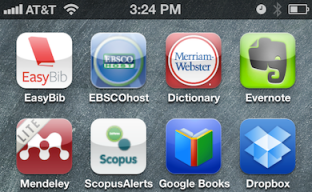
Ebsco Databases – Ebsco provides access to a large number of databases via one app (ERIC, Georef, American History and Life, MLA International Bibliography, Business Source Complete, Academic Search Complete and lots of others).  Because access to these databases is paid for by the library (with your tuition dollars), you need to log in to Academic Search Complete via your library’s website first.  At the bottom of the screen you’ll click on a link that will send an email with an activation code.  After downloading the app, open your email on your phone and click on the link.  You will then have 9 months of access.  I’ve found this process to be pretty simple and easy – no need to log in every time.  The app will connect you to full text articles within the Ebsco databases, and even Geneseo’s “Get it” service (our version of OpenURL) for articles found elsewhere.

SciVerse Scopus Alerts – A search app for the interdisciplinary database Scopus.  I’ve reviewed this app before, and there hasn’t been a major update since then.  This app can do keyword searching, citation tracking, and alerts for the science and social science literature.  Scopus is an outstanding database, but the app has some issues.  The biggest problem is getting it to work.  You need to remember your Scopus username and password (not your Geneseo username), and even then there can be trouble.  While the tech support is responsive, it just isn’t as easy to get started as the Ebsco app above.

Evernote – I recently started using this piece of software on my computer for note taking during meetings and lectures, lesson planning and writing.  I am in love with its simplicity and universal usefulness.  Take class notes on your computer, then download the iPhone app to access them anywhere.  Record voice notes on your phone and automatically sync them to your laptop.  Take pictures with your phone and insert them into the notes you’ve already started, or start a new note.  The iPhone app syncs with the desktop application so that you never have to guess where a certain piece of information is.  Share notes with others via shared notebooks or simple weblinks.  I love this app.

Dropbox – Along with the Dropbox website, this tool allows you to easily share files among friends (with shared folders), or between your computer and phone.

EasyBib – An app from the popular website.  This app allows you to scan the barcode of a book and create a formatted citation (which you will, of course, check against the style manuals for accuracy).

Merriam Webster Dictionary – There are lots of dictionary apps out there.  This one is free, and has a nifty voice search function.

Mendeley – This app works with Mendeley Desktop and the Mendeley website.  It allows you to store and organize your PDF journal articles and book chapters.  It’s like iTunes for journal articles: Mendeley will organize your folders for you and you can create folders (playlists) of articles.  You can share those folders with others to help you collaborate on group projects.  The desktop version integrates with Microsoft word to help you cite your sources.  This mobile app allows you to access the journal PDFs you have synced to the web, as well as the ability to search your personal library.  This is one of a few applications that is always open on my laptop, and I love the ability to quickly look things up on my phone when I am away from my computer.

Since I don’t have an Android phone, I can’t comment on the availability or usability of these apps on that platform.  Perhaps in another post.

What apps do you use to get your work done?

Keeping track of it all

Along with every other department on campus, libraries are under increasing pressure to evaluate their services – everything from student learning outcomes to expenditures.

Tally marks
Are your reference statistics a comedy or a tragedy? Image courtesy of Flickr user aepoc

Assessing the value of libraries in these areas requires the collection of lots of information.  Data of all kinds needs to be collected, analyzed and shared.  So what data do we collect, and where do we store it?

We have lots of silos for relevant information here in my library, and none of us are convinced that we are doing things in the best way possible.  Our collection of statistics related to reference and research help services provides one example.

The most obvious place where this happens is the reference desk.  To keep statistics about what happens here we use LibStats to record:

  • the question itself,
  • the format (phone, walk-up, IM)
  • the patron (student, community member, faculty member)
  • how long it took to answer

But our research help doesn’t end at the reference desk.  One of the big services we provide is research consultations by appointment.  Students (and faculty or community members) can request an appointment and their request will be routed to the most appropriate librarian.  (No one wants me answering in-depth research questions about primary sources in 17th century European history, for example.)

These requests come via an online form that dumps information into a home-grown MS Access database.  For this kind of appointment-based research help we collect the same information recorded for reference desk questions, but also information about the student and the course the project is related to.

But our research help comes in other forms, too.  We have an email-based ask a librarian service, and we all get email questions directly from students and faculty.  At this point we aren’t very good at recording this type of information.  What system should we use?

We also aren’t very good at recording questions that come directly to us from faculty, either via email, phone or in person.

And I haven’t even started to discuss the challenges of assessing the student learning outcomes associated with research and reference help services.

As a result of all this, it is difficult to get one complete picture of our involvement in research across campus.  It’s something we are currently working to resolve.

And the biggest question that will influence how we do this is

“What do we want to do with this information?”

Change our services?  Change our staffing levels? Merely collecting the data won’t be of use to anyone.  The answer to these questions will influence the type of data that we  collect and the tools we use to collect it.

And once we figure out all that, then we just need to remember to record everything.

Author Order

One of the parlor tricks I occasionally do in an information literacy class is to the guess the name of a researcher’s PhD adviser, and sometimes their Post Doc adviser, simply by looking at a list of their publications.  This is most impressive when the researcher in question is the faculty member I’m working with and can confirm or deny my guess.

Students are usually impressed, but it isn’t difficult: you just need to know a little something about the meaning behind the order of author names.

Scientific publications are rarely authored by just one person. More often, they have 3-6 authors, and sometimes many more, depending on the field. Publications in high energy physics and genetics can sometimes have hundreds of authors: the record (as far as I can tell) is an article related to the installation of the particle accelerator at CERN that lists the group as a lead author and almost 3,000 co-authors.

My colleagues in the humanities sometime have trouble understanding how so many people could be the author of a paper – they equate authorship with actual typing and writing of words.  But in the sciences, the words aren’t the primary result – it’s the data, discoveries and conclusions that are important.  As a result, scientific publications encourage contributors to list as authors anyone who made a significant contribution to the work.

The definition of “significant contribution” can vary by field, however, and it isn’t unheard of to see authors who only made a nominal contribution.  In some places it was customary to add the department chair or lab PI as an author, even if he or she knew nothing about the work (see this 2006 article in Nature.)  Some journals are attempting to get a better handle on this by asking contributors for a list of credits, who did what (see this example).  And the medical community has outlined specific criteria for inclusion as an author.

Because of the quantity of authors, some thought has to go into how they will be ordered on the publication. The first author is typically the person who contributed the most to the publication, including carrying out the research and writing up the report.  After that, it can get a bit tricky.

In order to combat the trickiness, various disciplines have evolved strategies to keep the peace.  In some disciplines, additional authors are listed alphabetically.  In others, authorship goes in order of who made the biggest contribution.  Sometimes, the person who contributed the most (after the lead author) will go in second place, sometimes in last place.

In cases where author order is determined by the relative amount of an individuals contribution, disagreements, and even arguments can sometimes result.  You can actually download software that aims to help establish the correct author order.

I sometimes discuss author order in upper level classes.  If a researcher understands how this works, their ability to search for additional relevant publications by author goes up.

Guest post on ACRLog

Readers of this blog may be interested in a guest post I wrote for the Association of College and Research Libraries blog, ACRLog.

Last week I taught an information literacy class to a group of senior Chemistry students. We didn’t talk about databases or indexes, we talked about numbers. We talked about impact factors and h-indexes and alternative metrics, and the students loved it. Librarians have used these metrics for years in collection development, and have looked them up to help faculty with tenure and promotion packets. But many librarians don’t know where the numbers come from, or what some of the criticisms are.

Read the rest of the post here.

Where should our information literacy standards come from?

From the ACRL? Or from the disciplinary organizations?

The ACRL Information Literacy standards have often frustrated me.  I struggle to find their usefulness to my day-to-day work, since the content of most of my information literacy sessions comes from conversations with the professor of the class, and are geared directly to student assignments.  As such, use of the standards usually involves fitting what I’m already doing back into the structure of the standards.  And because the standards are meant to apply to all disciplines, they suffer from being both too vague and too specific at the same time.

I also don’t find them very useful when it comes to convincing faculty members that their students need to learn information literacy skills.

On the other hand, the information literacy standards that come from disciplinary organizations like the ACS and the APA might actually be useful.

First, the faculty members might actually care about them.  Let’s be honest, when was the last time a faculty member was concerned about their students meeting the standards set out by the ACRL?  They are busy enough trying to meet their own standards and goals.

Secondly, because the disciplinary standards have been developed by faculty in the disciplines, they are more likely to align with the skills needed in those particular disciplines.  They are more likely to provide practical guidance about what to teach students, how papers and projects can be geared to meet the standards, and how this can be assessed.

Oh, and the disciplinary standards are typically shorter.

Am I abandoning the ACRL standards completely?  Probably not. But I would encourage librarians to make sure they are aware of any education related standards and outcomes set forth by disciplines they work with.  It might be useful.

Assessing Undergraduate Research Experiences

As part of some work I’ve been doing this summer for several different projects, I’ve started compiling a list of papers related to the assessment of undergraduate research experiences.  These papers include works that do simple surveys of student attitudes and papers that try to measure student learning outcomes (which is more difficult).

In order to share this list and hopefully get other folks to add to it, I’ve created an open group on Mendeley.

A collection of articles that discuss assessment methods used to describe a variety of undergraduate research experiences, including course-based research and traditional mentored research. Assessment methods include indirect surveys of student attitudes, direct methods of assessing student learning outcomes and many other strategies.

So far, the list has a modest 11 citations, but I’ll probably be adding a few more over the next few days.

So, if you’re using Mendeley, join the group and add resources to the list.

If you’re not using Mendeley, why not?


Asking the right questions

Sometimes, when I am asked to teach a library session for upper level classes, I will ask the faculty members what their student know about a particular aspect of library research.  They, in turn will ask their students some variation on “Do you know how to use Scopus?”  Unfortunately, the answers to this question are often less than useful – almost all students will say yes because they can all type a few keywords into the search box.

This is apparent in the formative assessment I do for an upper level class on evolution.  We want to know what the students know about the primary literature, so we ask them to fill out a survey prior to the library session.  Students are asked two open ended questions:

  1. What is a primary research article?
  2. How can you distinguish a primary research article from other types of scientific articles (websites, conference proceedings, review articles, news articles, etc.)?

At this level, the students can easily answer these questions with reasonably well thought out answers.  But these questions don’t evaluate if students can apply that knowledge.  So we add one more task to the formative survey.

Students are asked to look at 6 different examples of the scientific literature and indicate which ones would be considered “primary research.”  These are the items I used this semester (sorry, many of these are behind a paywall):

  1. Reproductive skew and selection on female ornamentation in social species – A letter from Nature, the methods are summarized at the end, and complete methods are in the supplemental material
  2. The fickle Y chromosome – A news story from Nature news reporting on a primary research article in the same issue
  3. The Evolution of Early Foraminifera – A primary research article from PNAS
  4. Genetic recombination – A wikipedia article
  5. Defeating Pathogen Resistance: Guidance from Evolutionary Theory – A commentary
  6. Evolutionary dynamics of a natural population: the large cactus finch of the Galapagos – A book

When I get to class, we start a discussion of the different types of scientific literature using these selections as a guide.

Most students understand that #1 is a primary research article, and a slightly smaller percentage pick #3 as well (the general title seems to throw them off).

None of the students pick #2 (news) or #4 (Wikipedia), but we talk about how resources like this can still be useful to them – using their references or for help in understanding complicated topics.

The Commentary (#5) is a format that is normally new to them, and we talk a bit about where you can find them and what their purpose is (highly varied).

The book (#6) is the most confusing for the students, and 50% of the students will often call this primary literature.  The book presents the final results of a “10 year study”, most of which has previously been published in peer-reviewed articles, but probably not all.  This precise example is in a bit of fuzzy territory, and it provides us with an opportunity to discuss the role of books in the scientific literature.

I like teaching this class, and I think it’s useful for the students.  It shows the importance of asking the right questions – asking someone “Can you do this?” might get a very different response than “Show me how you do this.”

“Amazon has never been just a river in South America”

"This sandstone is made of quite well rounded grains of quartz, cemented together by calcium carbonate. Cambrian, NW Scotland. Field of view 3.5 mm, polarising filters."
Sandstone in thin section, one of the topics of my Sedimentary Petrology class

It was early 1997 in an 8:30am Sedimentary Petrology course at St. Lawrence University.  With only 7 students in the class, we often got side tracked at the beginning and I distinctly remember my professor talking about some books he had just ordered on “Amazon.com”.

As a lover of bookstores I felt a bit underwhelmed by the offerings in New York’s North Country and my ears perked up.  An online bookstore?  They have everything?  I was very excited.

After class I went to the basement computer lab and fired up Netscape to check it out.  What wonders to behold!  With a clean design and access to all the books I could think of, I was in love.

Our entering first year students never had the moment of discovery for Amazon.com.  As the 2015 Beloit College Mindset List indicates:

12. Amazon has never been just a river in South America.

For these students born in 1993, the internet was ubiquitous by the time they were old enough to be aware of their surroundings.

And for the first time, I’m feeling a little old after reading the list.

A few things I read today

Researching then and now – This is an amazing blog post describing pre-internet research strategies.  Importantly, it captures the feelings and emotions of that type of research:

The ease of making photocopies led to a new joy: collecting them. There was a tendency to believe that something worthwhile had thus been achieved and that the content could be absorbed through osmotic proximity to the material.


How do you get feedback from library users? (Or, Beating Survey Fatigue…) – The comments on this post are the most useful.  As we all struggle to assess library services in line with institutional missions and student learning outcomes, there are some useful suggestions presented here.  The author illustrates the challenges of asking people what they want with a quote from Henry Ford:

On the Model T Ford: “If I’d asked people what they wanted, they’d’ve said a faster horse…”


Conference pitch: Research For More Effective Research – From Heather Piwowar, an idea for a conference that discusses research about how to make research more effective.  I want to go to this conference.

This sort of “research for more effective research” is already being done in several scattered areas, but it suffers from a lack of broad community and infrastructure for action.  Bringing together investigators, domain researchers, funders, publishers, educators, tool-builders, and experts in cultural change would allow exchange of methods, better understanding of which problems are most pressing, and support for making a difference.

The difficulty of counting scholarly activity

I had a really interesting conversation yesterday with my colleagues in our library’s Scholarly Communication Group.  It started with a simple question – should we keep track of faculty art?

One of the things this group does is try to keep track of faculty publications (via CiteULike and LibraryThing) and host a celebration in November celebrating our faculty authors.  We have alerts set up for author affiliations in relevant databases, and we also send out a call to faculty asking them what they published this year.

The biggest challenge is trying to figure out what should be on these lists and what shouldn’t.  In the case of books and journal articles, it’s a pretty easy call.  But what about other stuff? We would like to create a record of faculty scholarship without judging the quality of that scholarship.  That’s not our job. But in creating a list, we end up doing a bit of judging.

What's in and what's out?  Courtesy of the Boston Public Library on Flickr
What's in and what's out? Courtesy of the Boston Public Library on Flickr

For example:

  • Conference Proceedings:  some are peer reviewed, some aren’t.  Do we include all?  None?
  • Book reviews: while we wouldn’t normally include these on a list of faculty publications, some faculty have sent them along when we ask for them.  Do we say no?
  • Artistic works: How could we include this type of scholarship?  What would we include?  My colleague, the liaison to the School of Art was absent at this meeting, so we are no closer to a resolution.
  • Magazine articles:  If one of our economists had an article in The Economist, we would want to celebrate that.  But a letter to the editor of the local newspaper?  Not so much.

Our conversation rapidly delved into the disciplinary differences seen across campus.  Importantly, we recognize that scholarship in each field is different.  And we would like our lists and our party to be inclusive – once again, we aren’t trying to judge.

Last year, we had a faculty member complain that we were including the authors of journal articles as well as book authors in our celebration.  They felt that the work required for an article was slight compared with that of a book.  But this would largely leave out whole departments (like the sciences) where the highest level of scholarship is the primary research article.  Certainly the last thing we want to do is fan the flames of existing disagreements among faculty about what qualifies as “scholarship.”

So what’s the answer?  Well, there isn’t one really.  If you wrote a book or an article, let us know.  As for everything else, well, let us know about that, too.  We’ll try to figure it out without pissing people off.  And everyone will be invited to eat cake at the party.