Librarians need to publish in non-library journals

Now that I’ve convinced everyone to stop going to library conferences, I’d like to make the argument that we also need to start publishing in non-library journals.  Luckily, someone has already made the point for me, in a 2007 journal article that I just came across in the Journal of Academic Librarianship by Christy Stevens.

ResearchBlogging.org

Library journals are full of articles about the importance of information literacy instruction.  Blogs, library magazines and twitter posts all discuss the best ways to collaborate with faculty to teach students these skills.  On rare occasions, disciplinary faculty publish articles about collaborations with librarians.

But faculty aren’t reading library journals.  And they aren’t reading library blogs either.  And some faculty seem unaware of the services that libraries are currently offering (the excellent ProfHacker blog often illustrates this.)  And according to Stevens, librarians could do a better job of publishing in disciplinary education journals.  She highlights calls from various librarian authors over the past 20 years to reach out to faculty through the disciplinary literature.

Stevens examined “discipline specific pedagogical journals” – the teaching journals for college professors to look for articles about information literacy, or even just libraries.  She looked at a few of my favorites, including the Journal of Geoscience Education, the Journal of College Science Teaching, and the Journal of Chemical Education.  For each of these journals, she identified articles that mention library research and articles that focused on information literacy.  Some of these articles mentioned libraries in passing, some mentioned particular library-related assignments, others discuss information literacy in more detail. (Incidentally, I would love to see the list of publications she ended up with).

Overall, a relatively small number of articles were found focusing on information literacy or library-related assignments.  She concludes that while there is not a lot of evidence of faculty/librarian collaboration on information literacy issues in these journals, things have improved since similar studies were done 10 or 20 years ago.

Faculty are much more likely to read pedagogical publications in their own disciplines, and librarians need to reach out to faculty in order to facilitate effective information literacy instruction.

So, instruction librarians need to stop publishing great articles about faculty-librarian collaborations in library journals and start publishing these articles in disciplinary journals.

Sounds simple, right?  Let’s do it.

Stevens, C. (2007). Beyond Preaching to the Choir: Information Literacy, Faculty Outreach, and Disciplinary Journals The Journal of Academic Librarianship, 33 (2), 254-267 DOI: 10.1016/j.acalib.2006.08.009

I hate footnotes

I’ll admit it.  I am a librarian and I hate footnotes and endnotes.

I have often lamented the wide proliferation of citation styles.  I really wish publishers could all agree on one style of citation, but that probably won’t be happening anytime soon.

This afternoon I am trying to read an article that seems very interesting, but it has endnotes, making my preferred style of reading a journal article much more difficult.

For example, normally I start to read the first few paragraphs of the introduction, then skip to the references section to see who they are citing.  A nice neat alphabetical list makes this easy.

Footnotes, on the other hand, make it very difficult to scan the references cited.

Lost in a Good Book by Jasper Fforde
Lost in a Good Book by Jasper Fforde uses footnotes for comedic effect

Today, when I wanted to check on a particular reference, I turned to the end of the paper and found endnote #90 and read “Ibid”.  I kept looking up the list to see “Ibid. Ibid. Ibid.” until eventually I found an author and article title at endnote #85.  But then I have to keep going back up the list (of over 100 endnotes) until I saw a complete citation. In this case, I didn’t find it because it was buried in one of several paragraph long notes (note #76).  I had to turn to the “search” feature of my PDF reader to actually find the complete citation.

This is not user friendly.  I argue that a nice list of alphabetical references and author date in-text citations are the most user friendly (although my colleagues in the humanities may disagree with me vehemently).

I grant that footnotes or endnotes can occasionally be very useful for text explanations, but most of this explanation could often be done within the text.  And of course, there are authors who use footnotes to humorous effect (Jasper Fforde being one of my favorites).

OK, rant over.

The never ending literature search

I’ve mentioned it before: I like searching for information.  I like it so much, that sometimes I just keep going beyond the point where a rational person would stop and say “I have what I need.”

There is a lot of advice about conducting a literature search.  In fact, it is my job to give a lot of advice about how to conduct a literature search.  Much of this advice focuses on the literature search as a cycle, where you often need to return to earlier steps, like this image from the Workshop on the Information Search Process for Research (From the University of Calgary):

Information Search ProfcessBut there is rarely any advice about that last step, “Search Closure.”  How do I know when I’m done searching?

Perhaps many librarians have this problem, but it’s been hitting home recently as I try to manage several publication projects.  I’m rarely convinced that I found everything I need.

This can manifest itself in two ways.

First, the literature on the topic can be really extensive.  Have I actually found the most relevant papers?  Do I have anything to add to an already large body of literature?  At some point, I need to trust my own skills and say that I have found a sufficient amount of information for my needs.  I need to (perhaps repeatedly) tell myself that I probably don’t need to track down every single paper on the topic.

Second, I may not find much of anything.  Am I using the correct search terms?  Should I try other databases/search engines?  Is it really possible that I’m doing something that hasn’t been done before?  This is where I start asking colleagues for advice.  What keywords would you use?  Have you heard of anything like this before?  And at some point, I need to trust my own skills and examine the possibility that there just might not be anything published on my topic.

Of course, the never ending literature search is just one more excuse to put off the harder stuff: writing the actual paper.  (Perhaps writing this blog post about the never ending literature search is another excuse to put off writing the actual paper!)

Designing the survey seems like the easy part

Right now I am neck deep in information literacy assessment survey results.

The instruction librarians and I spent a lot of time devising our instructional goals and objectives and then developing the assessment tool (for a one-shot info. lit. session in a first-year writing course).  There were a lot of meetings, and it was a lot of collaborative work.

Since the analysis of the results falls largely on me, however, right now the survey design seems like the easy part.

The assessment tool we designed has a lot of short answer questions, which require a lot of thought in order to effectively ‘grade’.  We strongly feel that these questions provide a more accurate picture of student understanding, but they can be tricky to analyze.

For example, we asked the students how they can tell the difference between a scholarly and a popular source.  I need to figure out how to mark this answer from one of our students:

it will say peer reviewed

Completely correct?  Somewhat correct? Not correct?

So I will spend the next few days (weeks?) trying to figure out how to condense all of this information into a nice neat package.

We’ll see how it goes.

A review of the Scopus iPhone App

A little while ago I downloaded the new iPhone app from Scopus, called Scopus Alert Lite.  I have finally had a chance to explore it.

A screen shot of the search screen from the Scopus Alerts Lite iPhone App

The app is free, although your institution will need a subscription to Scopus in order for you to use it.  Theoretically, you should be able to register using your Scopus user id and password, plus the email address from the institution that provides your subscription.  This may encourage some users to sign up for an account.  Most of the users I know (faculty and students) don’t realize the benefits of creating a user account with the databases they use.  This simple authentication didn’t work for me, and it took several emails to Scopus support to resolve the issue.  The app does provide a button to contact support if you fail to authenticate, which was how I got in contact with the folks that resolved the problem.

Despite the challenges of registering, I believe that when it works, this is one of the better ways of authenticating subscription content for the iPhone.  You can use it anywhere, you don’t have to be on your campus WiFi network or use VPN (like the ACS app) or go through a proxy server (like some database mobile websites).

The app is rather slow to load, and several times I received an error message asking me to log in again.  Restarting the app seemed to solve the problem.

Because the app is focused on setting up citation and search alerts, not general searching, there are some limitations.

The biggest limitation is that, for any search, you can’t see more than 50 results, although it will tell you how many total results are available.  I think this is a badly needed feature.  I kept feeling like I was being short-changed.  You can change the sorting order of the results list.  The default is by date, but you can also sort by relevancy and citation count.

The second limitation seems to be with author searches.  Scopus.com has a very nice author ID feature, which helps you identify all works by the same individual no matter what permutation of their name each article uses.  The Scopus Alerts iPhone app doesn’t seem to take advantage of this feature.

Affiliation searches are very easy, allowing you to find publications from a particular institution.

For each of the articles found, you can get their citations and references (number of each and item information).  However, the app doesn’t provide links to publisher websites or institutional link resolvers to help you locate the full text (some publishers are providing their own apps for that.)

Unfortunately, alerts don’t transfer between web and iPhone – there is no way to access alerts you have already set up at Scopus.com, and it doesn’t appear that you can get your iPhone alerts on your computer at this time.

I am happy to see this first attempt at an app from Scopus.  Despite some challenges, I think their method of authentication is actually one of the easiest I’ve seen (once you set it up once, you are all set, and you don’t need to re-authenticate each time).  I hope to see some increased functionality in the future, especially access to additional search results.

You can read the complete official description of the iPhone app from Scopus (including an FAQ) on the Scopus website.

SUNY Librarians Association Conference Wrap Up

The SUNY Librarians Association Conference was last week, but only now do I have a chance to write about what I got out of the conference.

Like most SUNYLA conferences, there was a lot of useful stuff and just a few sessions that didn’t really add to my knowledge or provide me with any ideas.

I gave a presentation with two of my colleagues about strategies to reach out to faculty (slides and speaker notes are here) and the conversations afterward (in the session and on the way to lunch) provided a real glimpse at what SUNY libraries are doing, and other possible strategies that we could use.  For example, several libraries provide new faculty with a pot of money to buy books from the library.  The library liaison is responsible for helping the new faculty member spend their money, which provides a great opportunity for the faculty members and the liaison to get to know one another.  Other libraries made it a point of taking new faculty out for coffee, in order to share with them some information about the library, and to determine what their needs might be.  Another library actually provided a competitive grant for established faculty to get a small pot of money to purchase books to support new research directions.

Another excellent presentation was given by Suzanne Bell from the University of Rochester about her institution’s home grown institutional repository, called IR+ (open source, code available here).  One of the things that makes this repository unique is the not visible to the public workspace provided to each faculty member.  This repository doesn’t just serve as a final resting place for documents, but it provides researchers with sharing and version control services, allowing them to collaborate with other researchers (at U of R and other places) more easily.  I really like how this tool attempts to get into the researchers workflow much earlier in the process, rather than just accepting the final output, like most IRs.

This presentation sparked an excellent conversation with some of my colleagues at Geneseo about the possibilities for us to support faculty research, including some of the practical steps we need to take in order to do this.

The last session I attended was a presentation from two librarians about how to do a systemmatic review, a type of review article (kind of) that I was not very familiar with.  They gave a clear explanation of the process.  I wish there had been more time for questions but it was interesting.

Once again, a satisfying conference.  I look forward to next year.

Thoughts on teaching geology

As a write this, my GSCI 100 summer school students are taking their final exam (it isn’t cumulative, in case you are wondering).  The last six weeks represent my first full-course teaching experience since I joined the library world in 2005.

An image of the Marcellus Shale
An outcrop of the Marcellus Shale

It was fun and exhausting.

It was fun to talk about geology again.  I love my job, I love libraries, and I love the quest for information.  But my first love was the natural world, and the study of it through the lens of geology.  My librarian colleagues can attest to my occasional mini lectures on geologic topics (especially when they are trapped in vehicles on the way to conferences), but it was great to share more detail on these topics with a group of students.  I got to talk about climate change and the Marcellus Shale and flooding.  We talked about the recent earthquake that was felt in Western New York and the geology behind other recent earthquakes.

But it was also exhausting.  During summer school, a typical 14 week class is compressed into 6 weeks.  Which means that my preparation time for this class was compressed, too.  Because I haven’t taught an intro geology class in 5 years, and because the student’s textbook was new to me, I had a lot of prep work to do.  Most of my evenings (after my daughter is in bed) have been spent at my kitchen table on my laptop working on lectures and labs for upcoming classes.  Many nights, I have had to stay up late finishing grading or lectures!

Folks have been asking me, “Would you teach it again?”  I’ve said that I might.  Course prep for next time probably wouldn’t be as onerous, and the extra money is nice.  It is a great way to stay in the world of geology, and to share my love of this subject with students.  We’ll see what happens – the geoscience department may not need my help again.

The joys of small conferences

Today and tomorrow I am attending the SUNY Librarians Association Annual Conference, held at SUNY Brockport.  SUNYLA (as it’s known) is one of my favorite conferences, despite my recent call for librarians to stop going to library conference.

First, I get to find out about lots of exciting things that are happening at SUNY Libraries.  We are a pretty smart group of people, and I can learn a lot from my colleagues.  As a plus, the group is dominated by librarians from 2 and 4 year colleges, so the activities that are being presented almost always seem manageable.

Second, I get to see old friends and make new friends from the other campuses.  I find it much easier to meet people at a small conference like this than at the larger ALA or SLA conferences.

Third, it’s a great place to make a presentation to a forgiving audience.  Sometimes I’d like to share information with colleagues, but I don’t feel that what I’m doing is new and unique enough to warrant a major presentation or paper.  The SUNYLA conference is great for this kind of thing.  Plus I get more experience presenting.  This year I’ll give a small presentation about strategies for reaching out to faculty, and a larger presentation about using assessment to evaluate information literacy goals.

It should be fun.

A small collection of resources about the University of California ‘negotiation’ with Nature Publishing Group

This week, the University of California announced a possible boycott by faculty and researchers of Nature Publishing Group.  UC felt they had to act after NPG was proposing a 400% increase in the UC site license subscription cost.  The proposal is for faculty to stop submitting articles to the journal, stop reviewing articles, resign from editorial boards, etc., in addition to canceling subscriptions to NPG journals.

Open Access - one solution to exorbitate journal prices

Official resources about the ongoing issue:

A small selection of commentary by people smarter than me:

Is this the start of something?  I emailed the Chronicle of Higher Education article to the faculty listserv at my institution, and one person actually responded saying ‘thank you’ for sending along the article.  The library is just now formulating plans for an Open Access Week event on Campus – could this raise faculty awareness of some of these issues?

Is this what was needed to bring the problems with the scholarly research and publication economy to light?  Or will all of this be forgotten by the time the fall semester starts?

I guess we’ll find out.

What should my students call me?

During one-shot library instruction session, the issue of what to call the librarian instructor rarely arises.  Now that I’m teaching a geology class again as an instructor, the “what should students call me” question comes up.

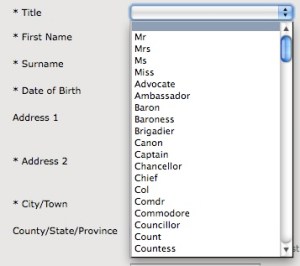
Title options for the Royal Opera House website registration form

Students often take the path of least resistance – they don’t call me anything.  Emails don’t begin with a salutation and there is rarely a need for them to refer to me by name in class.  I used to give extra credit on quizzes and exams if students could correctly answer the question “What is your instructors name?”  Fewer students than you would think got it right.

So far this summer, the students who call me anything seem to default to “Professor Swoger”.  Is this appropriate?  While I am the instructor for the class, and I certainly like to profess things, none of my official titles contain the words “professor”.  My “budget title” says Senior Assistant Librarian, my “local title” says Visiting Reference Instruction Librarian and the title on my business cards says Science and Technology Librarian.  We don’t use the term librarian as a title in the same way that professor is used.  “Librarian Swoger” sounds a bit odd.

Generally, I don’t correct students if they use the title Professor, but I do correct them if they default to “Dr. Swoger”.  I don’t have a PhD, so that title doesn’t apply.  I also have a sense that Professor also applies to PhD recipients or folks with the appropriate job title.

I’m kind of ambivalent about telling students to use my first name.  Sometimes I use it, sometimes I don’t.

Of course, I could be Mrs. Swoger, but I always look for my mother-in-law when that is used.  I prefer Ms.

So, when I send my class an email, how should I sign my name at the bottom?  Perhaps I’ll try to be consistent by the time the course ends, or I could follow the lead of my students and just not sign my name at all!