iPhone Apps for the Scientific Literature

There is no shortage of useful apps for scientists.  From compasses to calculators, the iPhone/iTouch has become a very useful tool for many scientists.

An increasing number of scientific literature producers are now offering Apps to let you search and read the scientific literature.  Here are a few:


iPhone sunset in the Andes
iPhone sunset in the Andes, courtesy of Flickr user Gonzalo Baeza Hernández


  • Nature.com – Free – From Nature Publishing Group, the folks who bring you the journal Nature.  You can search and browse journals, and read articles for free (until April 30, 2010).
  • ACS Mobile – $2.99 – From the American Chemical Society.  Browse and search across all ACS publications, get the latest news items from C&E News, and read full text articles for institutional subscribers via institutional WiFi or VPN.
  • PubMed On Tap – $2.99 – One of several applications available for searching PubMed, this app allows you to easily view PDF documents from PubMed Central and email them to yourself for future use.  Advanced searching techniques are also supported.
  • arXiview, ArXiv, ArXivReader – $0.99, Free, $0.99 – Multiple apps allow you to search papers deposited in the arXiv.org e-print repository for physics, math, computer science and quantitative biology
  • iResearch – Free – Browse and search journal articles from American Institute of Physics publications.  Access articles via institutional subscriptions.  Download articles for offline reading.
  • IOPscience Express – Free – Browse and search articles from the last two years from Institute of Physics publications

While there are a lot of useful apps for geologists, including a host of statewide geologic map applications, I can’t find any apps to search the geoscience literature.  In addition, there are notable gaps from some of the big science publishers including Springer and Elsevier.

Update (5/5/2010): Scopus (the citation database from Elsevier) now has an iPhone app.  They launched a “lite” app a couple of weeks ago, and so far I can’t find a paid app, but I’m guessing one might be coming.

Weeding – a.k.a. Recycling, Withdrawing, De-selecting

One of the challenges of being a small library is that we cannot collect or keep everything.  We don’t have the space to keep things “for historical purposes.”  We would like to keep acquiring materials, and this means that we have to find space somewhere.  This means weeding materials from our collection (aka, recycling books and journals).

Outside factors can make these space pressures more acute – in the summer, our library will be kicked out of one of our on-campus storage locations (the building will eventually be demolished).  We will be simply moving some of the materials to another location, but other materials will be withdrawn from the collection to make room.

I have been working on several projects to make this possible.

First, I have been looking at our print indexes to see what can be withdrawn.  Sometimes this is an easy decision: We can withdraw the print versions of Chemical Abstracts and the Bibliography of North American Geology because we have subscriptions to their electronic versions, and those subscriptions won’t be going away any time soon.  I know that some librarians will say “but those print indexes are valuable learning and research tools – it’s easier to use the electronic version when you know how to use the print.”  To be honest, I’m not sure that I agree with this statement, especially since the electronic tools offer so many more options for finding information.  In any case, we simply can’t afford to hang on to them.

The next items to go are low use print journal volumes that we have stable electronic access to.  This is a bit more complicated, because what does “stable” access mean?  Publishers who have made certain journal volumes open access now could always take away that access in the future.  What happens when we can no longer subscribe to online access for a journal?  These decisions were made on a individual basis.

At the same time I am looking at our collection of USGS documents with our government documents librarian.  Our collection is a bit odd.  Much of it was never entered into our OPAC, so we don’t have a complete sense of what we have.  Much of it is now available online, but access is a bit dodgy for students used to clicking on the open url resolver button in GeoRef (which doesn’t work as we’d like for these documents).  I’ll be meeting with our geology faculty in the next couple of weeks to develop a plan for these documents – I suspect we will withdraw items that are available online.

Recycling books is never pretty. Image courtesy of Flickr user Mark Blevis

And finally we have a large collection of books in the storage location that is being closed.  These books were moved out of our main library 5 years ago, based on their previous usage.  At the time, these books hadn’t been used (checked out or taken off the shelf) in 10 years.  Students could still check them out by requesting them from storage.  If they were requested they were put back in our main library.  So right now, the books in storage haven’t been used in 15 years.  Most of them will be withdrawn.  I plan to have a quick look through them, however, since they were moved before I arrived here.

Of course, one of the trickiest parts of this is communicating this with the faculty.  The most visible part of all this is the big recycling dumpster into which all of these volumes are thrown.  It isn’t pretty.  And you don’t want that dumpster to be the first clue to faculty about what is going on.  So I have been trying to communicate with faculty about what we are doing.  Sometimes I am asking for advice, sometimes I am simply informing them of our decisions.  And I haven’t always done this in the best way possible.  For example, I didn’t give the faculty a lot of notice about the Spring Break withdrawal of indexes.  At this point the only thing I can do is make a plan to communicate with faculty about the next phases.

So I will send emails and request face-to-face meetings with our department representatives over the next couple of months in an effort to be open with the faculty about our decisions.  Hopefully they will still see me as an advocate for science resources in the library.

Assessment without review, analysis and change is a waste of everyone’s time

Today I’ve been thinking about assessment:

  • I created a short survey to assess student learning after a one-shot library instruction session.
  • I compiled student bibliographies from Fall 2009 courses I’ve worked with, in the hopes of analyzing what these students actually did.
  • I’ve been thinking about how to effectively assess the information skills students (should have!) acquired during a Spring 2010 course I met with on 5 different occasions.
  • I made some final edits to a very brief survey of user satisfaction at the reference and circulation desks (modeled after Miller, 2008).
Scantron sheet
Hopefully we don't try to assess our students to point of exhaustion! Image courtesy of Flickr user MforMarcus.

I’m in the process of collecting a lot of data about how I well do my job.

What’s the next step?

If I just collect this data and report on it without making any changes, I have probably wasted everyone’s time.  It is unlikely that the assessments will indicate that I am doing everything perfectly.  The goal of assessing service, student learning, user satisfaction, etc. is to make these things better.

What kinds of changes can you make:

  • Change your focus – In some classes I realized that students had a very good understanding of one concept I was trying to teach, but a poor concept of another.  I was able to change the focus of my instruction to focus more on
  • Change your goals – In some cases your assessment might reveal that your original goals are out of line with what students need.  This happened at my library in the one-shot we taught for the First-Year writing class.  We were able to re-align our goals with student needs.  We’ll see if this helped our students when we do an assessment at the end of this semester.
  • Go back to something that was working better before you made a change – The user satisfaction survey I’m working on right now is being done just prior to some big changes in the reference/circulation/service desks at my library.  We plan to re-do the survey in the Fall and again in Spring 2011.  Perhaps we’ll find that the changes result in a decrease in user satisfaction, although I sure hope not.  It is theoretically possible that we will need to roll back some of the changes we made.

So, anyone have a quick and easy way to analyze student bibliographies?

A guide to help you understand academics and researchers

A bit of fun on the Friday before Spring Break:

In a department meeting, when an academic says “With all due respect,” what they really mean is “I’m about to be rude.”

If the department chair suggests, “Can we take this up next time?” they really mean “I don’t have my minions here right now.”

When the junior faculty member interrupts to say “I have a question.”, they really mean “I have a comment.”

The still-hanging-in-there professor emeritus says “As I recall, we do have a precedent for that,” but really means “As the longest-standing faculty member in the room, I can make up anything before 1970.”

If the faculty senate representative says “The dean has asked for our opinion,” it really means “He wants a rubber-stamp approval.”

The faculty member who never holds back says “I have issues with — “, but really means “I can’t tell you how much this pisses me off.”

When a scientist tells the press that a cool new technology will be available in 5 years, what they really mean is “I’ve solved the interesting research problems.  The rest is just business, which is easy.  Right?”

Spilled Coffee
Image courtey of Flickr user Miss_Colleen

If they say the cool new technology will be available in 10 years, they really mean “We haven’t finished inventing it yet, but when we do, it’ll be awesome.”

When a research article claims, “It has long been known”, the authors really meant to say “I don’t know the original reference.”

If the author states, “Three samples were selected for detailed study,” what they should have added is “Because the other ones sucked!”

When the article claims that “It is generally believed that” they really mean that “I think this and at least one other person agrees with me.”

Or if the author suggests that “Additional work will be required to elucidate the mechanism”, they really mean  “I don’t have a clue what is going on and I’m not going to be the one to figure it out.

And if the author says that they did “A careful analysis of obtainable data”, it may really mean “I analyzed what data I could, which wasn’t much because the other data was lost (chemical/coffee spill, computer error, equipment malfunction, etc.).”

References

Check out the links below for more translations.

Translation of the Last Department Meeting – At the U of All People

Researcher Translation – From the great xkcd.com

Interpreting Statements in Scientific Papers: What Common Research Phrases Really Mean – I saw a version of this hanging in my office in grad school in 1999

Off Balance

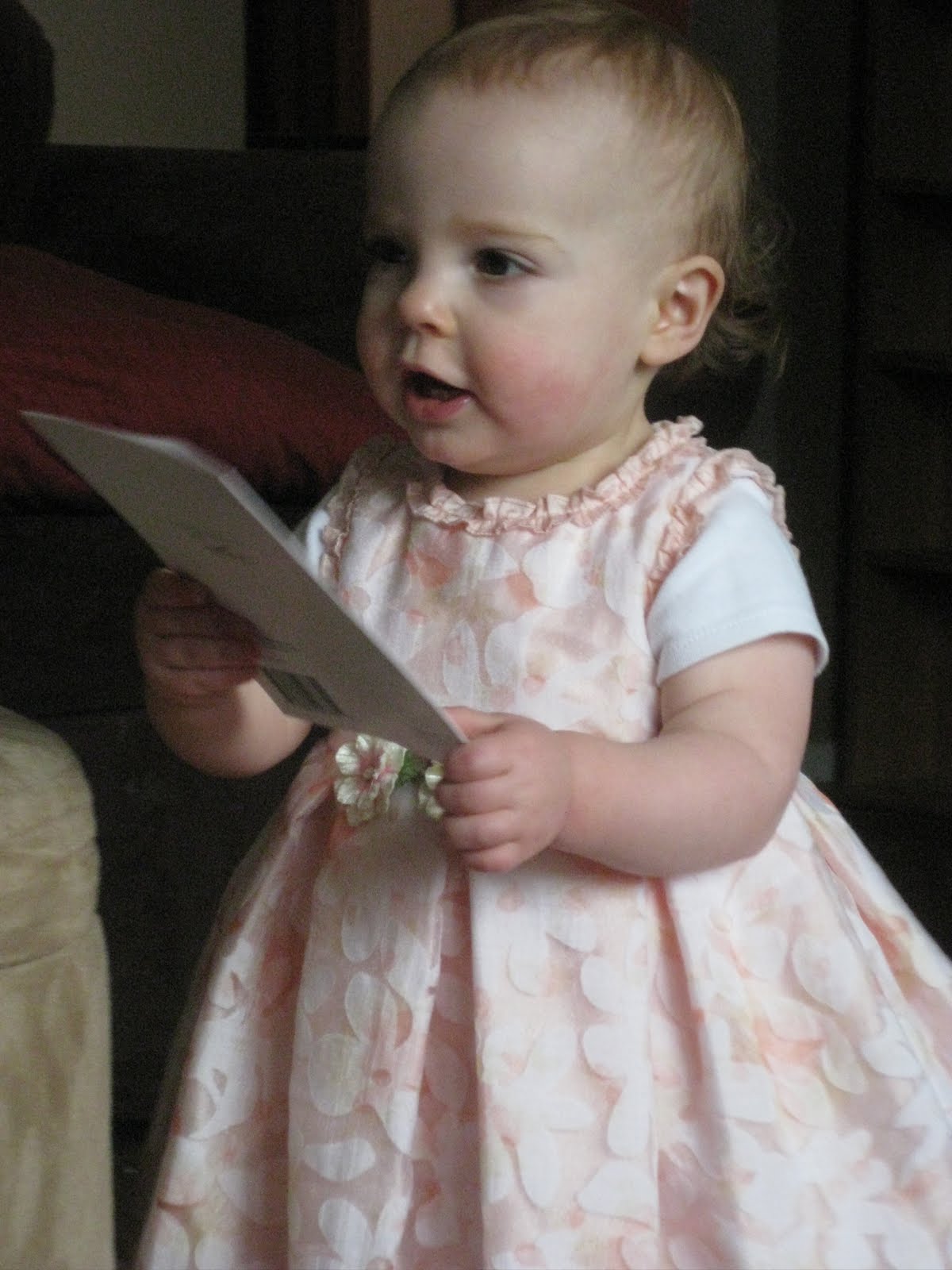
My daughter
My daugher, in the fancy party dress from her first birthday party

Occasionally, I read news articles or blog posts about the concept of a “work/life balance”, especially in academia.  Inside HigherEd recently had two interesting posts on the topic, ‘Balance’ is a Woman’s Issue and Balance is a Myth.  Normally I read these with interest, but also with a feeling that I have things pretty well figured out.  I have a wonderful partner who shares equal responsibility for housework and child care, and a library director who understands that 1-year old little girls have no respect for working hours or project deadlines..

The last couple of weeks have tested this perceived balance.  First, my husband became ill, and rapidly got sicker and sicker.  I finally bullied him into seeing a doctor, where we learned he had pneumonia.  His need for rest (and inability to get that rest while taking care of our daughter) piled the majority of household duties on me.  I now have an increased appreciation for those without supportive partners!  Second, a close family friend died unexpectedly.  In order to attend the funeral, I needed to re-arrange some reference desk hours and reschedule an information literacy session (thank goodness for understanding faculty).  At home, I needed to prepare my house for guests since I had family flying in to attend the funeral.

All of this led to a couple of off-balance weeks and more laundry than any sane person should have to do.  The feeling of having things pretty well under control is (at least temporarily) gone.  I am playing catch-up at work after taking a few days off to deal with everything, made even worse by the fact that my schedule has been very full this week.  At home, laundry sits unfolded, dishes tend to pile up, and I have a stack of household paperwork left undone on my desk at home.

So far, my schedule for next week is more open.  If I can make it through one more information literacy session tomorrow, a webinar with our our director of sponsored research and a seminar with the library director and provost, I think I might make it.  Hopefully I will have the time to work on projects that I have left languishing on my desk this week.

But the laundry may still not get done.  I hate laundry.