Scholarly Communication: What can my library do right now?

In January, 2010, my library formed a Scholarly Communication Group, of which I am a member.  One of our first activities was to honor a recent faculty publication (Broadway : an encyclopedia of theater and American culture by Thomas Allen Greenfield) that involved many campus authors.  After this celebration, we have struggled a bit to find our role at this small liberal arts college.

WNY-O ACRL LogoIn search of a well defined purpose for our group, I attended the recent Spring Conference of the Western New York and Ontario chapter of the Association of College and Research Libraries (WNY-O ACRL).  The conference theme was “Getting the Word Out: Scholarly Communication and Academic Libraries.”  I was hoping to get some ideas of things that we could do NOW, and to look at how we might be able to grow our scholarly communication efforts over time.  I wasn’t disappointed.

What can we do now?

  • We can help faculty interpret their publishing contracts, suggesting the SPARC author addendum when appropriate.
  • We can do the research and legwork to help faculty find a good journal to publish something new in.  They are probably already familiar with journals in their primary research area, but if their interests lead them in new directions, we may be able to help find a publication venue that meets their needs.
  • We can recommend tools and programs to help scholars manage digital information.  Bookmarking from Delicious, Connotea or Diigo.  PDF and reference management with Zotero or Mendeley (among others).  Customizing research databases like Scopus.  And lots more.
  • We can recommend programs and tools to better enable intra- or inter- campus collaboration (webinar software, Google Docs, etc.)
  • We have always offered assistance with literature searching and research consultations, now these activities can be combined under a heading of Scholarly Communication Services

What do I want our library do in the future?

  • Develop an institutional repository for undergraduate presentations, faculty publications, conference posters and presentations and anything else that folks want to put in it.  We need to set up a repository, figure out how we will manage it, and what we want in it.
  • Work with faculty to develop plans and strategies for managing their research data (especially now that NSF grant applicants may be asked for a “Data Management Plan”).  We need to learn about data management.  I suspect that many of our current skills will transfer nicely, but I need to learn a bit about it.
  • Assist faculty with NIH Pub Med Central Deposits (this shouldn’t be too hard to get started with, but we have very few NIH grant recipients at the moment)
  • Present faculty colloquia about scholarly communication issues.  I think we are getting started on this.

The conference sessions also gave me some important insight about how to discuss scholarly communication issues with faculty and administrators.  Austin Booth and Charles Lyons from the University of Buffalo presented the results of some surveys and discussions they’ve done with faculty to gauge faculty interest and knowledge of scholarly communication issues.  The short story is that (no surprise) faculty aren’t particularly interested in the serials crisis.  They are interested in their own publishing opportunities.  As a result, the question of open access (either gold or green via institutional repositories) may best be framed in terms of the impact on faculty publication.  Although there is still some debate, the studies evaluating the impact of open access seem to point to an increase in citations to articles that are freely available.

Although it was brief (just one day) and small (no more than 50 participants) it was an excellent conference that gave me a lot of ideas for the future of scholarly communications in our library.

Assessing Information Literacy Skills in First Year Students

A new open access journal, Communications in Information Literacy, recently published an article about assessing library instruction for first year students.  The paper caught my eye because I’m working on some similar things here at Geneseo.
ResearchBlogging.org
The study sought to determine if students’ information literacy skills and confidence with research improved more with a greater number of librarian-led information literacy sessions.  The author used a pre-test and a post-test to examine students’ attitudes and stated behaviors.  She used likert-style questions to assess students’ previous use of information sources and their confidence with various information related tasks.  One group of students received the typical one-shot information literacy session in a first year writing and critical thinking class.  Another group received two or three information literacy sessions over the course of the semester.

The author is very clear about outlining the challenges we all face in trying to assess information literacy instruction.  Most notably, it is almost impossible to control for the wide variety of variables that have an impact on student information literacy skills:

  • Prior information literacy instruction in high school or other venues
  • Prior practice doing scholarly research
  • Student intelligence and creativity
  • Opportunity to practice skills learned in an information literacy session (and differences in the assignment requirements)
  • Differences in scholarship between various disciplines

Some information related to the factors listed above is relatively easy to obtain (although perhaps not so easy to quantify).  Course faculty can be a source of information about assignment requirements, and will set the standards for more or less practice information literacy and research skills.

On the other hand, getting information about prior instruction and practice normally relies on students’ self reporting, which is not always accurate.

In addition to the likert-style attitudinal questions, the author analyzed student bibliographies.  She looked at the different types of sources used, and whether they were available through the library or through other sources.

The latter question is challenging.  Typically, a student doesn’t need to use a library database to access the full text of articles if they are on the campus network.  As a result, they could easily have used one of many search engines and not even realized they were using library resources.  On the other hand, use of library databases that resulted in articles requested through Interlibrary Loan would not count as library sources.  We emphasize ILL at my institution, however, so perhaps it isn’t used as much at other institutions.

All of this begs the question – are the information literacy sessions we teach an effective way of teaching students research skills?

The author of this paper concludes that there is some positive benefit to the increased number of information literacy sessions, although the data seem a bit more mixed to me.

I wish that the author had actually tested students research skills.  While it may be much more difficult to evaluate, student confidence does not necessarily correlate with student skills.

Julie K. Gilbert (2009). Using Assessment Data to Investigate Library Instruction for First Year Students Communications in Information Literacy, 3 (2), 181-192

How to Choose the “Best” Student Poster Presentations

Yesterday was SUNY Geneseo’s “GREAT Day” – a celebration of student achievement in the form of posters, presentations and performances.  There were 165 poster presentations and a similar number of oral presentations and performances.  Students presented research findings, class projects and original art.  It was amazing – our students are really quite smart and talented!

Great Day 2010
Geneseo Recognizing Excellence, Achievement, and Talent

Each year, the library selects a small portion of the posters to hang in the library for the following semester as an example of student work and research at Geneseo.  This year, the posters will also be displayed at a “Best of GREAT Day” event for college donors and board members.  The only issue is that these posters aren’t really the “Best of GREAT day.”  Librarians have 2 hours to review 20 student posters each and talk to the students involved.  We can’t really pick out the “best.”  (Next year, I think the event will have a name change to “Selections from GREAT Day.”)

So how do I make my selections?

Step 1: Delete the word “best” from the description.  Don’t worry about it.

Step 2: Talk to the students.  Do they know what they are talking about? Do they know how their research fits into the grad scheme of things?

Step 3: Find the interesting things.  Which posters showcase the variety of research being done?  Which posters have pretty pictures of students in exotic places?  Which posters have an interesting interdisciplinary appeal?

Step 4: Does the poster meet some minimum requirements for looking good?  I am not particularly concerned about how pretty a poster is, but I would like to see a certain level of competence.

Step 5: Stop dithering and make a decision already!  It is very difficult to narrow down my selection to just 25% of the posters presented.  At some point you just have to decide.

Have a look at some of the great things our students are doing – the GREAT Day program (PDF) is online.

A Different Approach to Plagiarism Prevention

First, we don’t call it “Plagiarism Prevention.”  In the approach I developed with a collaborating faculty member from biology, we teach students about “Citation Best Practices.”

Most students never have instruction on what plagiarism is or how to avoid it.  Library instruction about citation often focuses on creating the citation, not how to incorporate in-text citations into your document.

Wikipedian Protester
Wikipedian Protester. From the web comic xkcd.

The faculty member I work with decided that she would be willing to give up a bit of content time to discuss these issues with the students.  One of our major goals was that we didn’t want this instruction to be punitive – we didn’t want to focus on how bad plagiarism is.  Like many other plagiarism prevention strategies, we wanted to be positive and proactive.

We decided to focus on teaching students how to do citations properly – something they had probably not been taught before.

I spent some class time teaching students how to construct a proper citation, and how to tell what type of item they are citing (for example, how to tell the difference between an article or article abstract found through a Google search and a web page).

Then I discuss best practices for doing in-text citations.

First, I remind students that the articles they are using for their papers had authors – real, live people who did the experiments and wrote the papers.  When they cite their sources in their paper, they can acknowledge this in the language they use.

Biologists Smith and Jones (2005) discovered that something really exciting happened.

I provide some examples of how they may use their sources in different ways when writing their paper, and provide some sample language for incorporating the citations:

  • Using a source as background information
  • Using a source as an example
  • Criticizing or analyzing a source
  • Comparing two or more sources

At the end of a brief lecture discussing some of these issues, I provide students with sample paragraphs with citations. (See a sample power point lecture and sample paragraphs.)  Each paragraph uses some citations well, and others poorly.  We ask students to determine what is done well and how each sample could be improved.

In our class discussion about the examples we talk about:

  • How often do you need to insert a citation?
  • Citing sources at the beginning or ending of sentences.
  • Use (or not) of quotations in scientific papers.
  • What is implied if no citation is included?
  • What is considered common knowledge?

Does this cover all aspects of preventing plagiarism?  No.  We don’t touch on a lot of details, and we don’t go into the implications of what happens if you do plagiarize.  We don’t touch on cross-cultural issues of plagiarism, and we don’t go into detail about how to paraphrase or take notes so you don’t accidentally copy.

But by providing this type of instruction, we can help students write better papers, give them some strategies for avoiding accidental plagiarism, and make the connection between the term papers they are writing and the scientific literature.

Teaching Summer School

About five years ago, I left a job teaching introductory geology labs (and the occasional intro class) to move into the world of librarianship.   I don’t regret my move one bit – I really love my job.

But I still love geology.   And this summer I may have an opportunity to immerse myself in Introductory Geology all over again.  Presuming that enough students sign up, I will be teaching GSCI 100, “Our Geologic Environment,” during the first summer session here at Geneseo.

Some of the lovely local geology exposed at Letchworth State Park. Creative Commons licenced picture courtesy of Flickr user Linden_Tea

GSCI 100 N/Our Geologic Environment
This course is intended for non-science majors who have an interest in their physical environment. The course is designed to develop an understanding of the interaction of Earth processes, the environment, and the human population. Topics include Earth materials, natural resources, geologic hazards, environmental change, and global environmental issues.

I have been reminding myself which elements I need to include in a syllabus (What’s my office number, again? It’s the second cubicle on the right), and trying to figure out which topics I want to teach about.  I have downloaded (but not yet read) an article about using the news media in Introductory Geology classes.  I got to order a free copy of the textbook I will be using, and I’m pulling out interesting chapters from these books that I always said I would use in class if I taught geology again.

I will also be teaching the lab section that goes along with the introductory course.  I will get to play with rocks and maps and other fun stuff again.  Luckily I won’t have to design all of the labs – I will be able to use the pre-packaged labs that the department already has set up.

I’m nervous and excited about the prospect of teaching geology again 4 days a week for over two hours each day.  June is going to be a very busy month for me, because I will be doing this on top of everything else I have going on in the summer.

Since many librarians have an MS or an MA is a discipline other than librarianship (in addition to their MLS), I was wondering how often other librarians teach in their disciplines.  It doesn’t seem very common.  I know of librarians who teach as adjuncts in MLS programs, but I only know of one other librarian who teaches in her discipline.

iPhone Apps for the Scientific Literature

There is no shortage of useful apps for scientists.  From compasses to calculators, the iPhone/iTouch has become a very useful tool for many scientists.

An increasing number of scientific literature producers are now offering Apps to let you search and read the scientific literature.  Here are a few:


iPhone sunset in the Andes
iPhone sunset in the Andes, courtesy of Flickr user Gonzalo Baeza Hernández


  • Nature.com – Free – From Nature Publishing Group, the folks who bring you the journal Nature.  You can search and browse journals, and read articles for free (until April 30, 2010).
  • ACS Mobile – $2.99 – From the American Chemical Society.  Browse and search across all ACS publications, get the latest news items from C&E News, and read full text articles for institutional subscribers via institutional WiFi or VPN.
  • PubMed On Tap – $2.99 – One of several applications available for searching PubMed, this app allows you to easily view PDF documents from PubMed Central and email them to yourself for future use.  Advanced searching techniques are also supported.
  • arXiview, ArXiv, ArXivReader – $0.99, Free, $0.99 – Multiple apps allow you to search papers deposited in the arXiv.org e-print repository for physics, math, computer science and quantitative biology
  • iResearch – Free – Browse and search journal articles from American Institute of Physics publications.  Access articles via institutional subscriptions.  Download articles for offline reading.
  • IOPscience Express – Free – Browse and search articles from the last two years from Institute of Physics publications

While there are a lot of useful apps for geologists, including a host of statewide geologic map applications, I can’t find any apps to search the geoscience literature.  In addition, there are notable gaps from some of the big science publishers including Springer and Elsevier.

Update (5/5/2010): Scopus (the citation database from Elsevier) now has an iPhone app.  They launched a “lite” app a couple of weeks ago, and so far I can’t find a paid app, but I’m guessing one might be coming.

Weeding – a.k.a. Recycling, Withdrawing, De-selecting

One of the challenges of being a small library is that we cannot collect or keep everything.  We don’t have the space to keep things “for historical purposes.”  We would like to keep acquiring materials, and this means that we have to find space somewhere.  This means weeding materials from our collection (aka, recycling books and journals).

Outside factors can make these space pressures more acute – in the summer, our library will be kicked out of one of our on-campus storage locations (the building will eventually be demolished).  We will be simply moving some of the materials to another location, but other materials will be withdrawn from the collection to make room.

I have been working on several projects to make this possible.

First, I have been looking at our print indexes to see what can be withdrawn.  Sometimes this is an easy decision: We can withdraw the print versions of Chemical Abstracts and the Bibliography of North American Geology because we have subscriptions to their electronic versions, and those subscriptions won’t be going away any time soon.  I know that some librarians will say “but those print indexes are valuable learning and research tools – it’s easier to use the electronic version when you know how to use the print.”  To be honest, I’m not sure that I agree with this statement, especially since the electronic tools offer so many more options for finding information.  In any case, we simply can’t afford to hang on to them.

The next items to go are low use print journal volumes that we have stable electronic access to.  This is a bit more complicated, because what does “stable” access mean?  Publishers who have made certain journal volumes open access now could always take away that access in the future.  What happens when we can no longer subscribe to online access for a journal?  These decisions were made on a individual basis.

At the same time I am looking at our collection of USGS documents with our government documents librarian.  Our collection is a bit odd.  Much of it was never entered into our OPAC, so we don’t have a complete sense of what we have.  Much of it is now available online, but access is a bit dodgy for students used to clicking on the open url resolver button in GeoRef (which doesn’t work as we’d like for these documents).  I’ll be meeting with our geology faculty in the next couple of weeks to develop a plan for these documents – I suspect we will withdraw items that are available online.

Recycling books is never pretty. Image courtesy of Flickr user Mark Blevis

And finally we have a large collection of books in the storage location that is being closed.  These books were moved out of our main library 5 years ago, based on their previous usage.  At the time, these books hadn’t been used (checked out or taken off the shelf) in 10 years.  Students could still check them out by requesting them from storage.  If they were requested they were put back in our main library.  So right now, the books in storage haven’t been used in 15 years.  Most of them will be withdrawn.  I plan to have a quick look through them, however, since they were moved before I arrived here.

Of course, one of the trickiest parts of this is communicating this with the faculty.  The most visible part of all this is the big recycling dumpster into which all of these volumes are thrown.  It isn’t pretty.  And you don’t want that dumpster to be the first clue to faculty about what is going on.  So I have been trying to communicate with faculty about what we are doing.  Sometimes I am asking for advice, sometimes I am simply informing them of our decisions.  And I haven’t always done this in the best way possible.  For example, I didn’t give the faculty a lot of notice about the Spring Break withdrawal of indexes.  At this point the only thing I can do is make a plan to communicate with faculty about the next phases.

So I will send emails and request face-to-face meetings with our department representatives over the next couple of months in an effort to be open with the faculty about our decisions.  Hopefully they will still see me as an advocate for science resources in the library.

Assessment without review, analysis and change is a waste of everyone’s time

Today I’ve been thinking about assessment:

  • I created a short survey to assess student learning after a one-shot library instruction session.
  • I compiled student bibliographies from Fall 2009 courses I’ve worked with, in the hopes of analyzing what these students actually did.
  • I’ve been thinking about how to effectively assess the information skills students (should have!) acquired during a Spring 2010 course I met with on 5 different occasions.
  • I made some final edits to a very brief survey of user satisfaction at the reference and circulation desks (modeled after Miller, 2008).
Scantron sheet
Hopefully we don't try to assess our students to point of exhaustion! Image courtesy of Flickr user MforMarcus.

I’m in the process of collecting a lot of data about how I well do my job.

What’s the next step?

If I just collect this data and report on it without making any changes, I have probably wasted everyone’s time.  It is unlikely that the assessments will indicate that I am doing everything perfectly.  The goal of assessing service, student learning, user satisfaction, etc. is to make these things better.

What kinds of changes can you make:

  • Change your focus – In some classes I realized that students had a very good understanding of one concept I was trying to teach, but a poor concept of another.  I was able to change the focus of my instruction to focus more on
  • Change your goals – In some cases your assessment might reveal that your original goals are out of line with what students need.  This happened at my library in the one-shot we taught for the First-Year writing class.  We were able to re-align our goals with student needs.  We’ll see if this helped our students when we do an assessment at the end of this semester.
  • Go back to something that was working better before you made a change – The user satisfaction survey I’m working on right now is being done just prior to some big changes in the reference/circulation/service desks at my library.  We plan to re-do the survey in the Fall and again in Spring 2011.  Perhaps we’ll find that the changes result in a decrease in user satisfaction, although I sure hope not.  It is theoretically possible that we will need to roll back some of the changes we made.

So, anyone have a quick and easy way to analyze student bibliographies?

A guide to help you understand academics and researchers

A bit of fun on the Friday before Spring Break:

In a department meeting, when an academic says “With all due respect,” what they really mean is “I’m about to be rude.”

If the department chair suggests, “Can we take this up next time?” they really mean “I don’t have my minions here right now.”

When the junior faculty member interrupts to say “I have a question.”, they really mean “I have a comment.”

The still-hanging-in-there professor emeritus says “As I recall, we do have a precedent for that,” but really means “As the longest-standing faculty member in the room, I can make up anything before 1970.”

If the faculty senate representative says “The dean has asked for our opinion,” it really means “He wants a rubber-stamp approval.”

The faculty member who never holds back says “I have issues with — “, but really means “I can’t tell you how much this pisses me off.”

When a scientist tells the press that a cool new technology will be available in 5 years, what they really mean is “I’ve solved the interesting research problems.  The rest is just business, which is easy.  Right?”

Spilled Coffee
Image courtey of Flickr user Miss_Colleen

If they say the cool new technology will be available in 10 years, they really mean “We haven’t finished inventing it yet, but when we do, it’ll be awesome.”

When a research article claims, “It has long been known”, the authors really meant to say “I don’t know the original reference.”

If the author states, “Three samples were selected for detailed study,” what they should have added is “Because the other ones sucked!”

When the article claims that “It is generally believed that” they really mean that “I think this and at least one other person agrees with me.”

Or if the author suggests that “Additional work will be required to elucidate the mechanism”, they really mean  “I don’t have a clue what is going on and I’m not going to be the one to figure it out.

And if the author says that they did “A careful analysis of obtainable data”, it may really mean “I analyzed what data I could, which wasn’t much because the other data was lost (chemical/coffee spill, computer error, equipment malfunction, etc.).”

References

Check out the links below for more translations.

Translation of the Last Department Meeting – At the U of All People

Researcher Translation – From the great xkcd.com

Interpreting Statements in Scientific Papers: What Common Research Phrases Really Mean – I saw a version of this hanging in my office in grad school in 1999

Off Balance

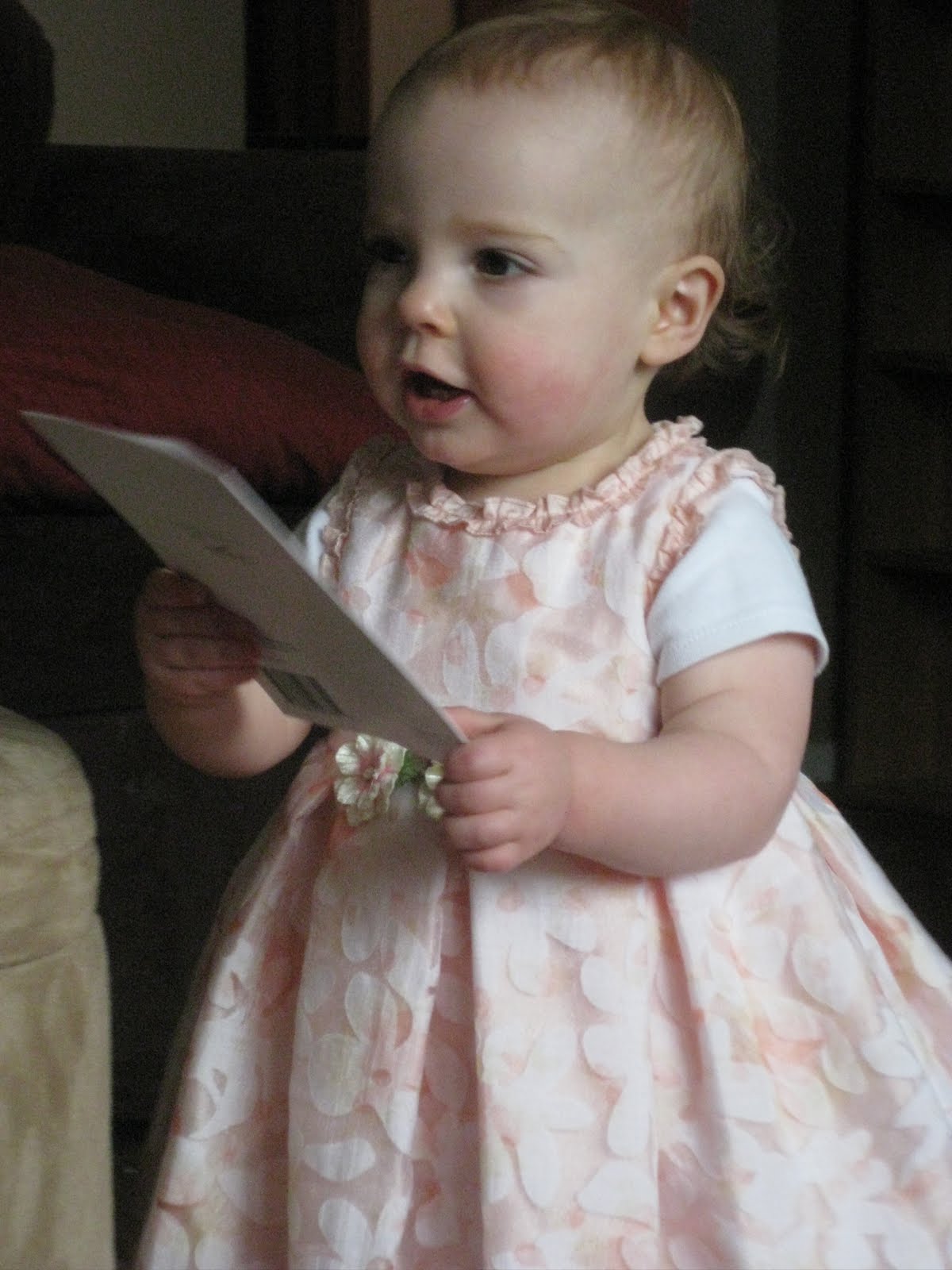
My daughter
My daugher, in the fancy party dress from her first birthday party

Occasionally, I read news articles or blog posts about the concept of a “work/life balance”, especially in academia.  Inside HigherEd recently had two interesting posts on the topic, ‘Balance’ is a Woman’s Issue and Balance is a Myth.  Normally I read these with interest, but also with a feeling that I have things pretty well figured out.  I have a wonderful partner who shares equal responsibility for housework and child care, and a library director who understands that 1-year old little girls have no respect for working hours or project deadlines..

The last couple of weeks have tested this perceived balance.  First, my husband became ill, and rapidly got sicker and sicker.  I finally bullied him into seeing a doctor, where we learned he had pneumonia.  His need for rest (and inability to get that rest while taking care of our daughter) piled the majority of household duties on me.  I now have an increased appreciation for those without supportive partners!  Second, a close family friend died unexpectedly.  In order to attend the funeral, I needed to re-arrange some reference desk hours and reschedule an information literacy session (thank goodness for understanding faculty).  At home, I needed to prepare my house for guests since I had family flying in to attend the funeral.

All of this led to a couple of off-balance weeks and more laundry than any sane person should have to do.  The feeling of having things pretty well under control is (at least temporarily) gone.  I am playing catch-up at work after taking a few days off to deal with everything, made even worse by the fact that my schedule has been very full this week.  At home, laundry sits unfolded, dishes tend to pile up, and I have a stack of household paperwork left undone on my desk at home.

So far, my schedule for next week is more open.  If I can make it through one more information literacy session tomorrow, a webinar with our our director of sponsored research and a seminar with the library director and provost, I think I might make it.  Hopefully I will have the time to work on projects that I have left languishing on my desk this week.

But the laundry may still not get done.  I hate laundry.